Why Do I Keep Numbing Out? How EMDR, IFS, and Somatic Therapy Help with Substance Use and Other Coping Behaviors
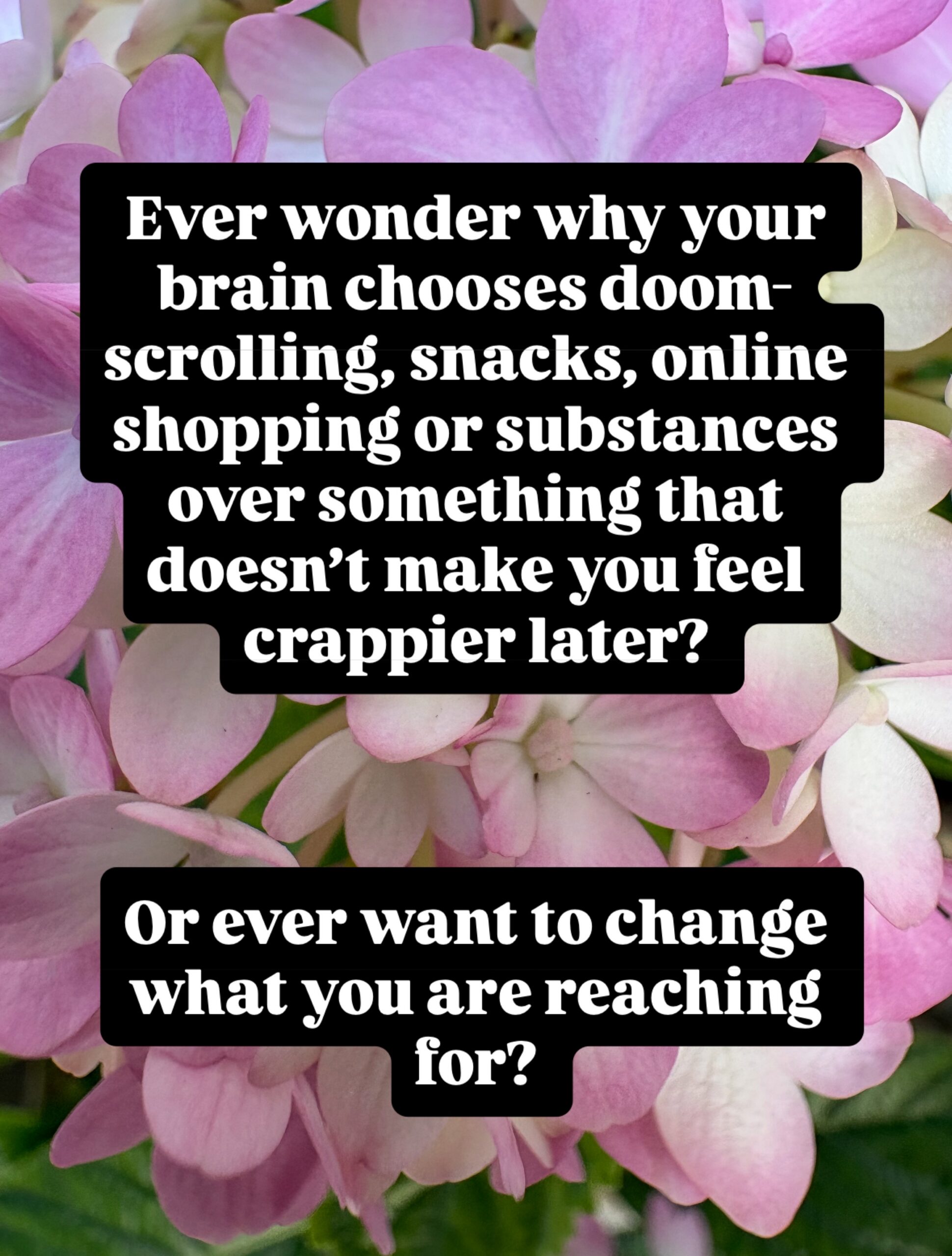
Ever promise yourself you’re only going to check your phone for five minutes, only to realize an hour has passed and you’re still watching videos of bees sleeping inside flowers?
Or maybe your version looks different.
Maybe it’s:
- One more glass of wine
- Another trip to the pantry
- Online shopping after a stressful day
- Scrolling social media until midnight
- Marijuana, nicotine, or other substances
- Constantly staying busy so you never have to slow down
Most of us have something we reach for when life feels overwhelming.
And while it’s easy to label these behaviors as “bad habits” or “poor coping skills,” that explanation often misses something important.
From a trauma-informed perspective, numbing behaviors are not signs of weakness.
They’re signs that you’re wanting to get away from uncomfortable experiences and these options help temporarily reduce that distress.
Why We Numb Out
When we experience emotional pain, stress, uncertainty, grief, trauma, loneliness, shame, or overwhelm, our nervous systems naturally seek relief.
This is not a character flaw.
Your parts value feeling good or better, we don’t usually want to feel stressed out, anxious, triggered, overwhelmed etc.
“How do I reduce distress?”
Sometimes we might engage in activities that help us feel better afterwards.
A walk outside.
Talking with a friend.
Rest.
Movement.
Connection.
And sometimes it discovers faster forms of relief that make us feel like crap later.
Scrolling.
Shopping.
Food.
Alcohol.
Substances.
Avoidance.
The problem with some of these is that many coping behaviors provide temporary relief while creating longer-term consequences.
The Nervous System Isn’t Trying to Sabotage You
Many people become frustrated with themselves.
They say:
“I know this isn’t helping.”
“I don’t want to keep doing this.”
“I don’t understand why I keep going back to it.”
What if the question isn’t:
“What’s wrong with me?”
But instead:
“What is this behavior helping me avoid, manage, or survive?”
From a nervous system perspective, numbing behaviors often serve an important purpose.
They help us escape difficult emotions, body sensations, memories, fears, uncertainty, loneliness, grief, shame, or stress.
In other words, the behavior may not be the problem.
The behavior may be the solution your system found.
Internal Family Systems (IFS): Understanding the Part That Wants Relief
In Internal Family Systems therapy, we don’t view the part of you that reaches for a substance, your phone, food, or shopping cart as the enemy.
Instead, we become curious.
IFS asks:
What is this part trying to do for you?
Often the answer is protection.
The doom-scrolling part may be trying to distract you from loneliness.
The drinking or smoking part may be trying to help you relax.
The shopping part may be trying to create comfort.
The overeating part may be trying to soothe emotional pain – eating initiates the rest and digest which engages the parasympathetic nervous system and mellows us out.
When these parts feel judged, they often work harder.
When they feel understood, something begins to shift.
The goal is not to eliminate the part.
The goal is to help it discover that there are other ways to help you.
I love how IFS can help build more compassion for ourselves and others: Compassion in IFS Therapy Colorado-Internal Family Systems Counseling – Colorado Wildflower Counselingcompassion-ifs-therapy-colorado
Somatic Therapy: Healing the Urge in the Body
A tight chest.
Restlessness.
Emptiness.
Pressure.
Anxiety.
Agitation.
A sense that something feels unbearable.
Somatic therapy helps us slow down and notice what is happening inside the body before we automatically act.
Rather than immediately reaching for relief, we learn to:
- Notice body sensations
- Build capacity for distress
- Increase our ability to sit through the entire nervous system regulation cycle
- Develop a sense of safety within ourselves
Over time, the urge often becomes less overwhelming.
Not because we forced it away.
Because the body no longer needs it as desperately.
EMDR Therapy and the DeTUR Protocol
One of the most effective EMDR approaches for substance use and compulsive behaviors is the DeTUR Protocol.
DeTUR stands for:
Desensitization of Triggers and Urge Reprocessing.
Developed by EMDR therapist Arnold Popky, DeTUR helps address the triggers and urges that drive addictive or compulsive behaviors.
Instead of focusing only on stopping a behavior, DeTUR helps identify not only positive reasons for finding another way to manage distress, but also anchors in times you feel strong and confident.
- Emotional triggers
- Environmental triggers
- Underlying memories
- Distressing experiences connected to the urge to avoid
Using bilateral stimulation such as eye movements, tapping, or auditory tones, the brain begins processing these experiences differently.
As the underlying distress decreases, the urge often loses intensity.
Many clients describe it as though the craving no longer has the same magnetic pull.
More about EMDR therapy in general: Heal Trauma and patterns with EMDR Therapy Colorado
Trauma, Stress, and Numbing Behaviors
Not everyone who struggles with substance use or compulsive behaviors has experienced major trauma.
However, many people have experienced:
- Chronic stress
- Attachment wounds
- Emotional neglect
- Anxiety
- Burnout
- Grief
- Overwhelming life transitions or the news cycle
When the nervous system spends long periods in survival mode, relief becomes incredibly important.
That’s why healing often requires more than willpower.
It requires helping the nervous system experience safety again and the ability to sit with distressing experiences.
Healing Is Not About Taking Away Your Coping Strategies
One of the biggest fears people have is:
“If I stop doing this, how will I cope?”
That fear makes sense.
Because the behavior likely helped you survive something.
It’s about helping you develop additional options.
It’s about creating enough safety that you no longer need to escape your life quite so often.
You Deserve More Than Relief
Most people seek numbing because they’re trying to feel better.
But healing offers something deeper than temporary relief.
It offers:
- Connection
- Presence
- Regulation
- Choice
- Self-compassion
And perhaps most importantly:
The ability to be in your own life without constantly needing to escape it.
Therapy for Substance Use, Anxiety, and Nervous System Regulation in Colorado
At Colorado Wildflower Counseling, I work with adults experiencing:
- Substance use concerns
- Anxiety and overwhelm
- Trauma
- Intrusive thoughts
- Emotional avoidance
- Expanding our nervous system awareness and finding our way back to grounding and more
Using EMDR, Internal Family Systems (IFS), and somatic therapy, we work toward understanding the deeper reasons behind coping behaviors and creating lasting change.
Virtual therapy is available throughout Colorado.
Frequently Asked Questions About Numbing, substance use, and what people like to call maladaptive coping tools (but they’re actually very adaptive!)
Why do I use substances or numb out when I’m stressed?
Substances (or doom scrolling, shopping, eating, gaming etc) often provide temporary relief from difficult emotions, nervous system activation, anxiety, or overwhelm. Therapy can help address the underlying causes driving the urge.
Can EMDR help with addiction and substance use?
Yes. EMDR, including the DeTUR Protocol, can help reduce triggers, cravings, and distress connected to substance use and other compulsive behaviors.
Does IFS work for addiction?
IFS helps identify and understand protective parts that use substances or other coping behaviors to manage distress, shame, anxiety, or emotional pain. We can work on befriending these parts so that we get space from the urges and go from there.
Can somatic therapy help reduce cravings?
Somatic therapy helps increase awareness of body sensations, improve nervous system regulation, and build capacity to tolerate distress without immediately acting on urges.
Virtual therapy available across Colorado.
Call, text, or email now for a free consult to get started.
Contact – Colorado Wildflower Counseling
Check out my instagram here, also. Naomi-EMDR, IFS, Somatic therapist in Colorado (@coloradowildflowercounseling) • Instagram photos and videos
Naomi Greenstone, LCSW is an EMDR-certified therapist in Colorado specializing in trauma, anxiety, intrusive thoughts, attachment wounds, nervous system regulation, Internal Family Systems (IFS), and somatic therapy.